

January 5, 2023, Posted by Absolute Destruction
Last Updated:
Key Takeaways
- Use an HRIS to keep employee records organized and easy to maintain.
- If you use spreadsheets or physical records, assign a designated custodian and keep files current.
- Digitize your physical employee records when possible to simplify storage.
- Follow a clear records retention schedule to keep files accurate and manageable.
- Good record storage helps support compliance and smoother HR workflows.
Employee records contain some of the most confidential information an organization manages. Payroll records, employment contracts, performance reviews, tax documents, and personnel files all contain sensitive personal information that must be protected throughout their entire lifecycle, from secure storage to compliant destruction.
Knowing how long to keep employee records, how to maintain them, and when they're eligible for secure destruction helps reduce privacy risks, supports compliance with Canadian record retention requirements, and protects former employees from identity theft.
How Long Should You Actually Keep Employee Records?
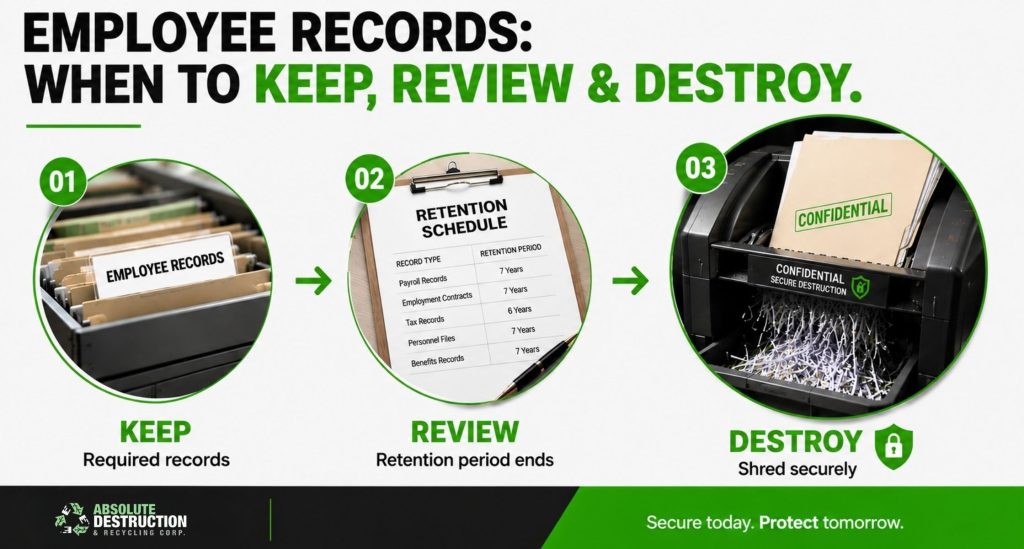
In Ontario, employers are generally required to retain employment records for the duration of employment and for a specified period after an employee leaves the organization. Under the Employment Standards Act, many employment records must be kept for at least three years, while vacation records often require longer retention. Businesses must also comply with Canada Revenue Agency retention requirements for payroll and tax records, along with applicable federal or provincial privacy legislation governing personal information.
Rather than relying on individual departments to manage records independently, establish a records retention schedule that clearly identifies how long each document must be kept, where it's stored, and when it becomes eligible for secure destruction.
Employee Records That Commonly Require Retention
An effective records retention policy should include clear retention timelines for documents such as:
- Employment History: Contracts, offer letters, job descriptions, and records relating to an employee's professional history.
- Payroll & Compliance Assets: Wage information, tax forms, vacation records, benefits documentation, and time tracking logs required to satisfy a formal CRA Business Records Audit.
- Personnel Files: Performance reviews, disciplinary documentation, training records, promotions, and workplace accommodation records.
- Health & Safety Documents: Workplace safety documentation, medical leave records, and other employment documents subject to specific legal retention periods.
Keeping records beyond their required retention period can create unnecessary risk. The more confidential information an organization stores, the greater the potential impact if those records are lost, accessed without authorization, or exposed during a data breach.
How to Store Employee Records Securely
Employee records should be easy to locate, protected from unauthorized access, and maintained throughout their required retention period. Whether records are stored digitally or on paper, a consistent system helps support compliance, reduces administrative work, and makes future audits or record requests easier to manage.
Start with a Centralized Record Keeping System
Before selecting a storage method, establish clear procedures for how employee records will be managed.
A strong recordkeeping system should include:
- A central location for all employee records.
- A designated custodian or authorized records personnel responsible for maintaining files.
- Consistent file names and folder structures.
- A documented records retention schedule and internal record-keeping policies.
- Restricted access so only authorized employees can view or update records.
Keeping records organized from the beginning makes them easier to maintain throughout their lifecycle.
Choosing the Right Storage Method
Different organizations manage employee records in different ways. The right solution depends on the size of the organization, the volume of records, and ongoing compliance requirements.
HRIS
An HR information system (HRIS) centralizes payroll, benefits, time tracking, and compliance records in one secure location. Many platforms include an auditing function, retention reminders, permission controls, and advanced reporting and analysis tools that simplify record management.
Spreadsheets
Spreadsheets can work for small organizations, but they become increasingly difficult to maintain as employee records grow. Multiple versions, manual updates, and limited security controls make them less practical for long-term record management.
Physical Records
Many organizations continue to maintain physical records, particularly legacy files. Securely storing paper documents requires locked storage, consistent file organization, and controlled access. Where practical, businesses should also digitize physical employee records to improve accessibility while reducing storage space.
Protect Employee Records from Unauthorized Access
Employee files contain sensitive personal information that should only be accessible to authorized employees. Strong data protection measures help reduce the risk of cybercrime, a data breach, and accidental disclosure while supporting Canadian privacy laws.
Consider these best practices:
- Restrict access using role-based permissions.
- Enable multi-factor authentication for digital systems.
- Encrypt electronic records and backups.
- Regularly review user permissions.
- Consider security frameworks such as SOC-2 compliance and zero trust architecture when evaluating digital record systems.
Keep Records Current
Employee record management doesn't stop once documents are filed. Regular maintenance keeps records accurate and makes future record retention and document disposal much easier.
Schedule routine reviews to:
- Update employment contracts, promotions, and employment history.
- File new payroll and benefits documentation promptly.
- Confirm records are stored in the correct employee file.
- Remove duplicate working copies.
- Review files against your records retention schedule to identify records approaching their legal retention period.
Maintaining complete and organized records throughout their lifecycle makes it easier to respond to audits, employee record requests, and safe document destruction when records are no longer required.
Why Should You Securely Dispose of Employee Records?
Employee records contain a wealth of personal information, including:
- names,
- physical addresses,
- social insurance numbers,
- dates of birth,
- email addresses, and
- phone numbers.
This makes employee paperwork a treasure trove of resources for ruthless thieves, leaving current and former team members open to identity theft.
Identity theft is a serious crime: it happens when an imposter attempts to adopt someone else’s identity to then commit fraud in their name. They can use key pieces of information to open bank accounts, obtain lines of credit and apply for credit cards.
Should employee paperwork fall into the wrong hands, the company will be left open to lawsuits, and confidence in the business will falter for current and future staff, and among clients and collaborators.
Responding to Record Requests and Audits
Well-organized employee records make responding to internal audits, government requests, and employee record requests much more efficient. Relying on an up-to-date records retention schedule ensures your organization can locate information quickly while meeting strict privacy law obligations.
When questions arise about a specific employment history, retention periods, or compliance concerns, always consult legal counsel before releasing or destroying sensitive files. Maintaining accurate, organized documentation is your best defence to demonstrate full compliance during formal regulatory reviews.
Abiding by Consumer Data Protection Rules
During an active inquiry, businesses must carefully balance disclosure requirements with consumer data protection rules. Under Canadian privacy frameworks, companies are required to implement strict access controls to ensure that only authorized investigators view sensitive files. For a deeper look at your legal responsibilities during an unexpected data inquiry, review the federal guidelines on safeguarding personal information to make sure your internal review processes remain fully protected.
Professional Document Destruction vs. In-House Shredding
Office shredders may be suitable for occasional paperwork, but they can become time-consuming and difficult to manage when disposing of employee records in larger volumes. Confidential documents also remain exposed while they're collected, transported, and shredded internally.
Working with a professional document destruction provider simplifies the process. Absolute Destruction offers secure on-site and off-site shredding services, scheduled collection programs, and locked security consoles that help keep confidential employee records protected until they're destroyed.
Every completed service includes a Certificate of Destruction, providing documented proof that confidential records were securely destroyed. It also gives businesses confidence that employee information has been handled in accordance with their internal records retention policy and privacy obligations.
Avoid Costly Breaches: Securely Dispose of Employee Records
The longer confidential employee records remain in storage after their legal retention periods, the greater the risk of unauthorized access, accidental disclosure, or a costly data breach. Absolute Destruction helps organizations securely destroy confidential records while supporting internal recordkeeping policies, privacy law obligations, and ongoing compliance. From one-time cleanouts to scheduled document destruction, every service is backed by a Certificate of Destruction for added peace of mind.
FAQs
How long must I keep employee records in Ontario?
Under Ontario's Employment Standards Act, most core employee files must be retained for at least three years after an individual leaves your organization. However, the Canada Revenue Agency (CRA) mandates a longer timeline for financial compliance, requiring all related payroll records and tax forms to be stored safely for six years. Always cross-reference your records retention schedule to balance provincial labour rules with federal tax requirements before planning disposal.
What's the difference between an HRIS and spreadsheets for recordkeeping?
An HR information system (HRIS) centralizes payroll, benefits, time tracking, and compliance records in one secure platform with SOC-2 compliance, audit logs, and advanced reporting and analysis tools. Spreadsheets work temporarily but become unwieldy as volume grows, lack encryption, and have limited data protection measures. HRIS platforms support defence-in-depth strategies and zero trust architecture for stronger security.
How do I protect employee records from cybercrime and data breaches?
Implement role-based access controls, enable multi-factor authentication, and encrypt all electronic records. Use zero trust architecture principles to verify every access request. Conduct quarterly access reviews and maintain audit logs for all file access. Consider SOC-2 compliant vendors and apply defence-in-depth strategies to protect sensitive personal information throughout its lifecycle.
What records should be included in a personnel file?
Personnel files should contain employment contracts, offer letters, job descriptions, performance reviews, disciplinary documentation, training records, and promotion history. Separate sensitive files like FMLA-related medical records, accommodation requests, and health documentation with restricted access. Never include personal information unrelated to employment, such as medical records or financial data unrelated to payroll.
How do I respond to employee record requests and audits?
Maintain a centralized recordkeeping system with a designated custodian or records personnel responsible for file management. Use your records retention schedule to locate documents quickly during internal audits or privacy law obligations. Keep audit trails of all access and changes. Consult legal counsel before releasing sensitive files to ensure compliance with employment eligibility documents and record retention requirements.
When is it safe to dispose of old employee records?
Records are safe to eliminate once they clear their maximum statutory retention windows under the CRA and provincial guidelines, provided there are no active legal holds, structural audits, or ongoing insurance investigations. Once a file hits its official expiration date, it must go straight to a secure data destruction pipeline to avoid accidental over-retention liabilities.
What is the safest way to dispose of physical employee records?
Relying on standard office paper shredders wastes valuable staff time and leaves sensitive documents sitting completely exposed in open trash areas. The safest method is utilizing a professional service like Absolute Destruction. We supply secure, locked collection consoles directly to your office floor and deploy mobile shredding trucks to destroy your confidential paper records right at your curb.
What's the best way to destroy digital employee records and electronic files?
Simply pressing delete or using standard drive-wiping software does not permanently erase data from old hardware; tech-savvy criminals can easily recover fragments of old payroll systems or databases. True digital security requires a certified hard drive and media destruction service. Physically crushing old laptops, hard drives, and legacy backup tapes into raw scrap metal is the only way to ensure the data is 100% unrecoverable.
How do I create a records retention schedule?
Start by identifying all document categories: payroll records, employment contracts, personnel files, health and safety documents, and tax forms. Research federal statutory retention periods and provincial requirements for each type. Assign retention timelines, storage locations, and destruction dates. Review your schedule annually and update it when legislation changes. This becomes your core recordkeeping policy for audits and compliance reviews.
Should I digitize physical employee records?
Yes, where practical. Digitizing physical employee records improves accessibility, reduces storage space, and makes it easier to maintain a records retention schedule. Use consistent file naming conventions and store digital files in a central location with role-based access controls. Keep original paper documents only if legally required or for legacy records. Securely destroy paper copies after digitization using a paper shredder or professional service.
What are defence-in-depth strategies for HR data security?
Defence-in-depth means layering multiple security controls: encryption at rest and in transit, role-based access controls, multi-factor authentication, audit logging, and regular access reviews. Combine technical controls with policies like restricted supervisor access to personnel files and quarterly permission audits. Consider zero trust architecture and SOC-2 compliance when evaluating HR tech stack options. These measures reduce cybercrime risk and support privacy law obligations.
How do I handle sensitive medical records and workplace health files?
In Ontario, employee health documentation and workplace accommodation requests are subject to strict privacy rules under the Personal Health Information Protection Act (PHIPA). These sensitive assets must be stored completely separate from general personnel files with highly restricted internal access. When their retention window closes, they should never be thrown into general recycling; they must be dropped immediately into a locked console for specialized, certified shredding.
What are the legal consequences of improper document disposal for my business?
Discarding intact employee or customer files invites immediate data privacy breaches, targeted identity theft, and severe corporate exposure. Under Canadian privacy legislation like PIPEDA, negligent waste habits can trigger invasive legal investigations by privacy commissioners, heavy compliance fines, and serious reputational damage that can permanently break consumer trust. Every destruction run handled by Absolute Destruction concludes with an official Certificate of Destruction to serve as your bulletproof legal proof during a regulatory audit.